
Stop Fusing Your Identity With What Impresses Everyone Else: Part 1
Regain perspective during challenging times.

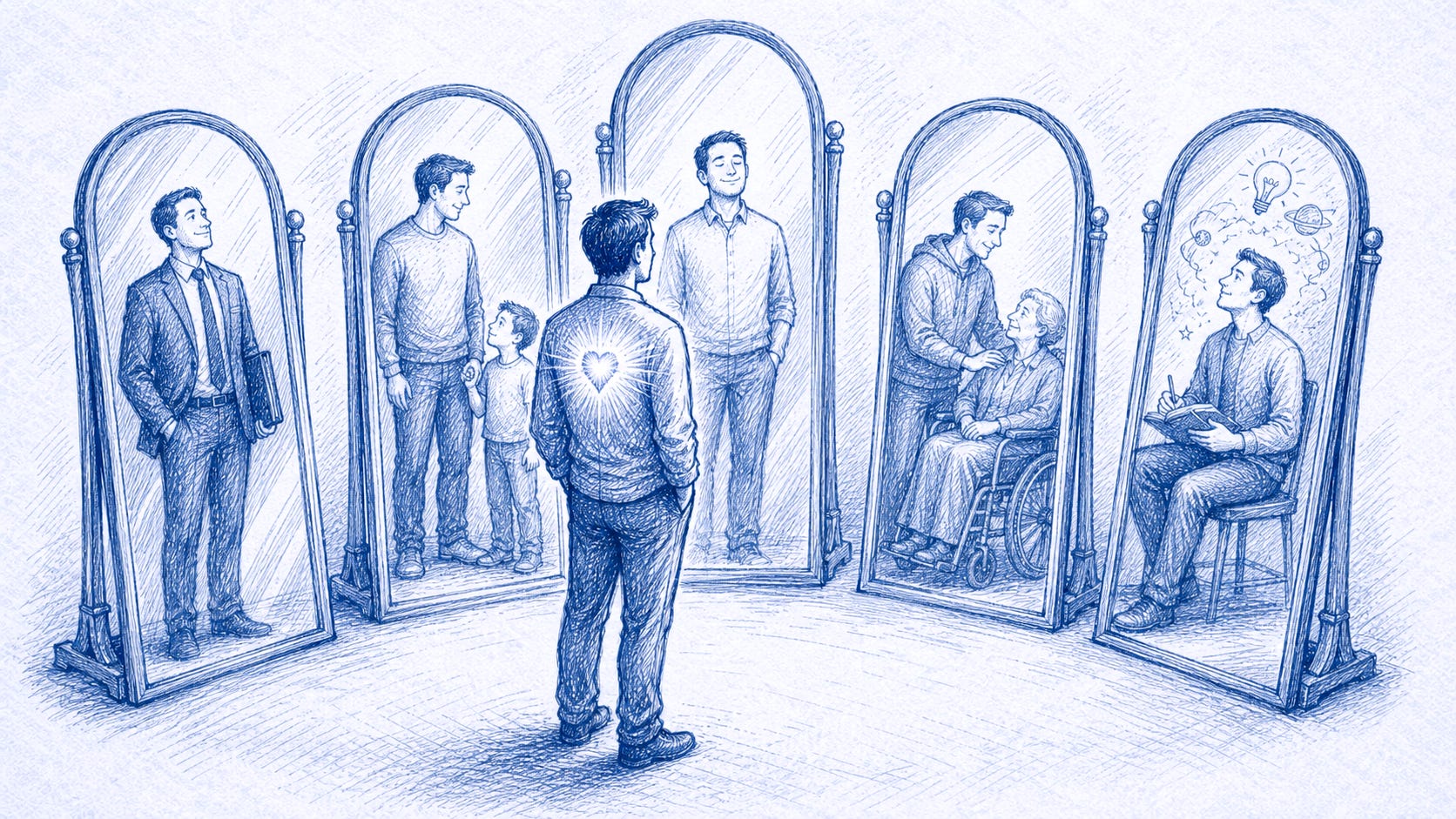
You know the pattern when someone else’s approval starts feeling like oxygen, when feedback follows you into the shower, or when a vague comment someone made is something you analyse at midnight. That is usually the sign that you have made one domain of your life the centre of your identity.
This is one of the most subtle traps of modern life. At first, an area of your life, such as work, is simply something you do. Then it becomes something you are proud of. Then, if you are not careful, it becomes the place where you seek proof that you are capable, valuable, respected and safe. Before long, every email, meeting, performance review, shifting priority and vague expectation starts carrying more emotional weight than it should.
Most people do not lose themselves overnight. They slowly become fluent in describing a life that impresses everyone else, while overriding the life that feels true to them.
The world often rewards the version of you that is useful, productive, reliable and easy to understand. You get praised for being capable, so you become more capable. You get praised for pushing through, so you push harder. You get praised for being impressive, so you keep performing. Then one day you realise the version of you that everyone respects is also the version of you that feels the most exhausted and discontented.
That is where misalignment begins. Not always through one dramatic decision, but through a series of small compromises that make external validation feel safer than internal honesty. You may know, somewhere within yourself, that something feels off. You may feel it in your body before you can explain it in words. But because the life you are living looks responsible, respectable or successful, you override that quiet signal and keep going.
If we could look into the future and see the cost of ignoring ourselves, perhaps we would make different decisions earlier. But we are not psychics. What we do have is something we often dismiss too quickly: intuition. That quiet internal knowing that tells us when something is out of alignment, even before we have perfect evidence or the words to articulate it.
When you turn down the volume of outside noise, what remains is often your judgement, your values and the part of you that already knows what deserves your attention.
A familiar scenario: when approval becomes your safety zone
If feedback feels personal, unclear expectations feel threatening, and work stress follows you home long after the day has ended, the problem may not be your workload alone. It may be that your career has quietly fused with your identity.
Think of the moment someone asks, “What do you do for a living?” Many of us do not simply say, “I work as…” We say, “I am…”. I am a manager, I am a lawyer, I am a nurse, I am an auditor, I am a founder, I am a consultant.
It seems harmless, and in many ways it is. But sometimes that small language shift reveals something deeper. Work has moved from something we do into something we use to measure who we are.
Caring about your work is not the problem. Wanting to do well is not the problem. Ambition, discipline, excellence and high standards are not the problem. The problem begins when approval becomes the main place you seek safety, validation, belonging and proof of your value.
This is what I call identity fusion: the point where a role stops being one part of your life and starts carrying the emotional weight of your whole self.
And when your identity feels like it is on the line, the mind cannot rest.

This is also why chasing validation is just a hamster on a wheel.
It never ends. There is always another target, another comparison, another person to impress, another standard to meet and another version of yourself you think you need to become before you finally feel secure, worthy and accepted.
The difficult truth is that validation can reassure you for a moment, but it cannot stabilise you for a lifetime. If your identity depends on approval, you will always need another dose of reassurance to keep yourself steady.
And even if you satisfy one opinion, there are countless others that may not approve. It is like taking part in a race with no finish line.
Zooming out: seeing the full picture again
Our minds are exceptionally good at narrowing focus when something feels uncertain, emotionally charged or threatening. This narrowing is not a weakness. It is often biology doing what biology does. The issue is that if we never deliberately widen our awareness again, we begin living as though the loudest problem is the whole of who we are.
This is why perspective matters. Not as a vague inspirational idea, but as a practical skill. Perspective reminds you that one domain of life is not your entire life.
A useful metaphor is to imagine your life as a camera lens. When you zoom too far into one problem, everything else disappears from the frame. The problem may be real, but the frame has become too tight.
Before you keep reading, pause for a moment and ask yourself: which part of my life currently feels bigger in my mind than it actually is in my whole life?
The Wheel of Awareness: regain perspective
The illustration below is an adaptation of Dr Dan Siegel’s Wheel of Awareness. At the centre sits you — the whole person. Not your job title, not your salary, not your reputation, not your current stress, but you.
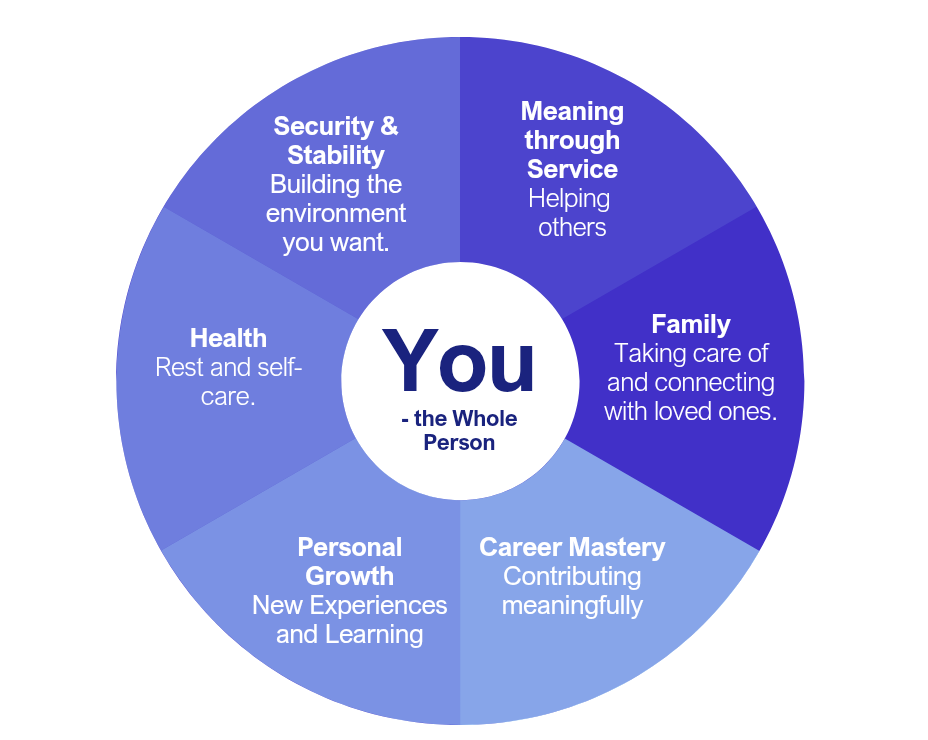
Radiating outward are the different domains of life that create meaning, stability and perspective. Work is one domain. Family may be another. Friendship, health, rest, values, creativity, learning, faith, contribution, parenthood, community and your inner life may all form part of the wider wheel. Your career, for instance, was never meant to sit at the centre of your identity. It was meant to be one part of a much larger life.
You are not your role, your performance review, your income, your title, or someone else’s perception of your worth. None of these things go to the grave with you, so they were never meant to carry the full weight of who you are while you are here.
You are a whole person, and when you remember that, your mind can finally stop treating every challenge as a threat to who you are.
Next week, we will go one layer deeper: if your role is not your identity, then what actually gives your life meaning, and how can you identify your real purpose in less than five minutes?
This deeply resonates with me. Especially the idea that misalignment rarely happens overnight. It happens through a series of small compromises that feel reasonable in the moment. Until one day you look up and realise the version of everyone else respects is also the one that feels most exhausted.
I find this piece highly profound! ✨ It speaks so much volume. Thank you so much for sharing. 💙