
The 10 Biggest Global Problems of 2026 (And Why Clarity Is Now a Survival Skill)
A diagnosis of real-world complexity. And the missing skill nobody taught us.

Last week, I spoke to a senior professional who looked successful on paper but couldn’t answer a simple question: what are you actually optimising your life for?
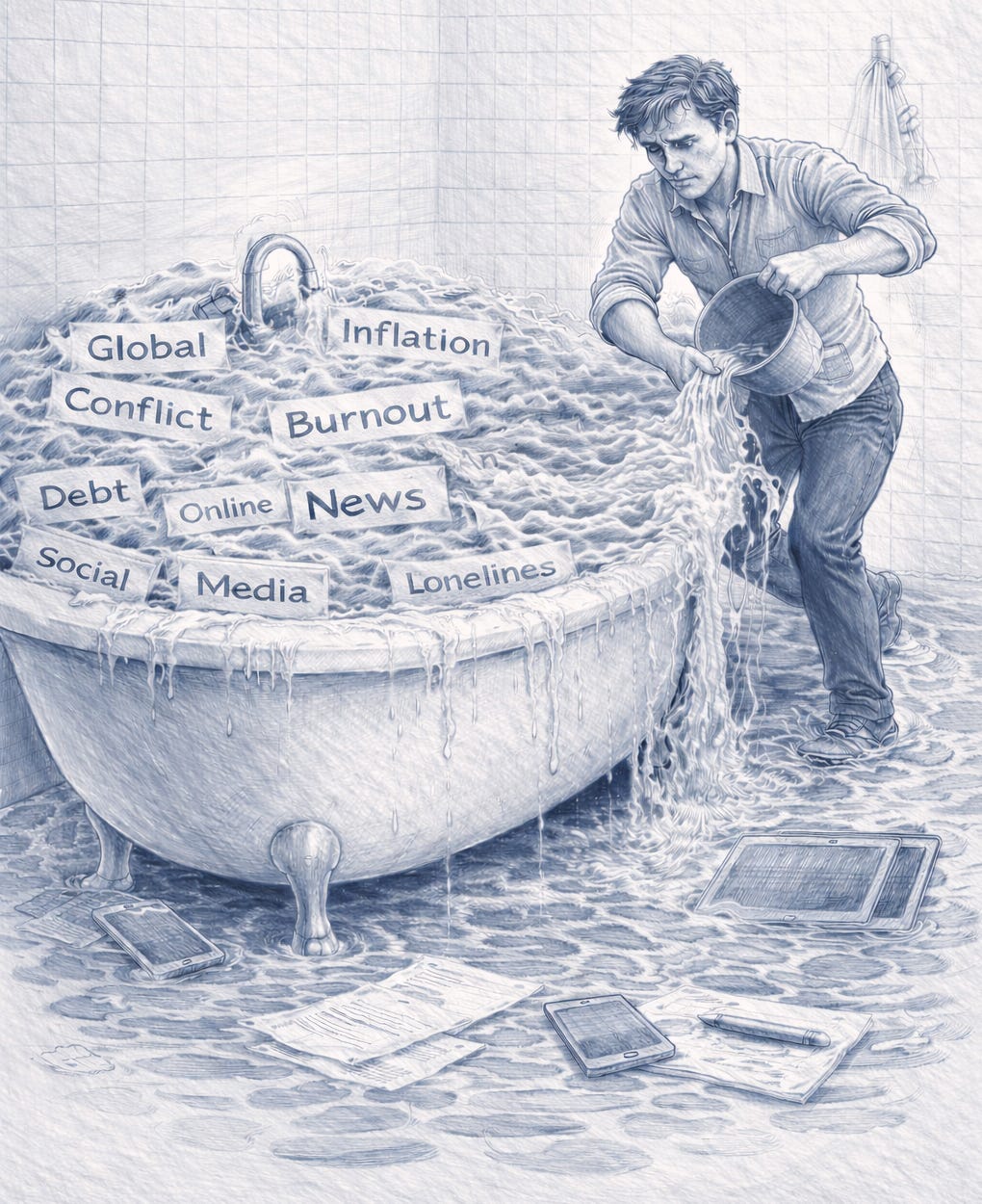
Every day, we are navigating overwhelming amounts of information alongside rising societal expectations, what I often refer to as noise: constant inputs competing for your attention.
The modern world doesn’t lack answers.
It lacks evidence-based judgement which operates as a psychological filtering system.
I see this constantly: high-performing professionals who look successful but really feel lost, overstimulated parents quietly carrying everything, and people who tell me “nothing is wrong… but nothing feels right.”
So let’s zoom out and get clear on the bigger picture.
Here are the ten biggest problems shaping human life in 2026, backed by global data. These are not isolated issues, but form a connected system of noise.
What is apparent is that building awareness of the root cause of our suffering, in any given situation, is already half the battle.
10. Mass displacement & global instability
Over 120 million people worldwide are now forcibly displaced. According to the United Nations High Commissioner for Refugees, this is the highest number ever recorded. It also means that roughly 1 in every 69 humans are living away from home due to conflict or crisis.
Even if you’re not directly affected, the ripple effects are showing up in everyday life:
Geopolitical tension from ongoing wars.
Economic volatility contributing to cost-of-living pressure.
Pressure on public systems that influence laws and services.
Social fragmentation driven by political and religious division.
This level of uncertainty becomes the background noise of daily life, and its impact is unavoidable.
9. Climate risk becoming daily-life risk
Climate-related disasters have increased fivefold over the past 50 years, and extreme weather now affects over 3.5 billion people globally.
Climate change is no longer abstract. It now impacts insurance premiums, housing decisions, and how safe people feel about the future.
This is another layer of complexity added to already crowded minds.
8. Decision fatigue & choice overload
The average adult now makes over 35,000 decisions per day, while being exposed to up to 10x more information than people encountered two decades ago. Cognitive research consistently shows this volume reduces decision quality and increases impulsive behaviour.
It often looks like endless browser tabs, half-finished to-do lists, and the quiet procrastination of the tasks that actually matter. It is no wonder why much of the population feels mentally stuck and unable to effectively move forward.
Careers. Parenting approaches. Health advice. Investments. Relationships. Spirituality.
More choice in each of these tabs doesn’t create freedom.
People delay decisions, overthink small ones, and rush big ones. As a result, clarity-first thinking quietly slips away.
Feeling all too familiar already? Lets quiet the noise in your life so that you can stop wasting your time, energy and money on the wrong fixes.
7. Artificial Intelligence (AI) acceleration & human displacement anxiety
Studies estimate that up to 40% of current jobs will be significantly impacted by AI over the next decade, with white-collar roles among the most exposed.
People are now rightfully asking:
Will my role exist in the future?
What value do I actually bring?
How do I compete with these changes?
Here’s the part that should calm some of the fear around AI.
AI can generate ideas and solutions. But it cannot replicate human judgement and intuition which are based on lived experience.
That gap is becoming one of the defining challenges of rapid technological change.
This is exactly why learning how to diagnose problems clearly matters more than ever.
6. Collapse of trust
Global trust surveys show that over 60% of people now distrust governments and media, and nearly half believe leaders intentionally mislead them.
When trust drops, people assume bad intent and interpret any ambiguity as a threat.
This doesn’t just affect politics.
It affects workplaces, families and communities.
When trust collapses, tolerance for uncertainty collapses with it.
5. Cost-of-living pressure and economic uncertainty
The Organisation for Economic Co-operation and Development (OECD) reports that real wages in many developed economies remain below pre-2021 levels. In addition, the International Monetary Fund continues to warn about persistent global uncertainty.
Despite pockets of wage growth, real purchasing power remains constrained across much of the developed world, while household debt continues climbing.
Financial stress doesn’t just change budgets. It changes risk tolerance, long-term planning, emotional stability, relationship dynamics, and personal fulfilment.
This level of pressure narrows thinking, especially when your primary focus becomes keeping a roof over your head.
4. Burnout disguised as ambition
Over 40% of workers globally report experiencing high daily stress, even in roles with flexibility and autonomy. This is one of the biggest contributors to the mental health epidemic.
Burnout today rarely comes from doing too much.
It comes from doing the wrong things for too long.
Effort without direction slowly drains people. How do you know you’re one of these people? Ever felt like you had the busiest day but wonder what value it really added to your life?
No technological development can tell us what to prioritise better than our own intuition and judgement.
3. Loneliness and social disconnection
Roughly one in six people worldwide report feeling chronically lonely, with health impacts comparable to smoking 15 cigarettes a day.
Both the World Health Organization and the American Psychological Association link loneliness to increased illness and emotional distress.
People are socially busy, yet internally feel unsupported.
When resilience weakens, stress amplifies, and our ability to think clearly when making decisions diminishes.
2. Global mental health deterioration
Over one billion people now live with mental health conditions, according to the World Health Organization.
This isn’t simply clinical diagnosis.
It’s chronic mental strain driven by ambiguity, unresolved inner conflict, and constant cognitive overload.
This is why it is important now more than ever that we develop a clarity-based thinking process in our lives to filter out the relentless noise.
1. Information overload and misinformation (The root beneath everything else)
We live in the most informed era in history, yet decision quality is declining.
The World Economic Forum continues to rank misinformation and disinformation among the top global risks. In addition, it was found in a 2011 study that false information spreads six times faster than facts, while the average person consumes the equivalent of 174 newspapers’ worth of content daily. Imagine how much larger this figure would be today.
Information therefore does not equal accurate judgement. We need to have established thinking processes that effectively help us determine what deserves our focus and what doesn’t.
What does this mean? People now disagree not only on solutions, but also on reality.
When truth fragments, trust declines and judgement collapses. People swing between paralysis and reactivity just to stay afloat.
This problem therefore sits beneath every other issue on this list because it erodes clarity of purpose, direction, and priorities.
The resulting feelings we have are the symptoms we can no longer put band-aids on.
The impact of these problems on your life
The lived experience of these interconnected challenges often looks like:
Burnout that doesn’t resolve with rest.
Anxiety that doesn’t respond to productivity hacks.
Careers that look fine but feel empty.
Relationships strained by unspoken assumptions.
Leaders making expensive decisions under pressure.
Parents quietly drowning while holding everything together.
What these symptoms and solutions demonstrate is that there is no motivation problem.
Based on all of the global issues outlined above, it is apparent that there is a widespread issue with adopting a clarity-based thinking process when diagnosing the root cause of our suffering.
The Clarity Loop™: your lifelong diagnostic thinking process
Most people jump straight to surface-level solutions. They try to escape discomfort by changing jobs, chasing motivation, adding routines to already busy lives, or consuming more content.
I’ve seen this pattern repeatedly.
A manager I worked with couldn’t understand why his team was underperforming despite having all the “right” controls in place. Budgets were met, reports were on time, and performance targets were being continuously monitored. Once we slowed down, the real issue emerged: there was no shared clarity about priorities or ownership. Everyone was busy, but no one was aligned. The same root cause can be identified even in our personal lives.
That moment reinforced something important for me: without an accurate diagnosis, any action we take simply repeats the problem (and can even worsen it).
This is why I created the Clarity Loop™ which is a full diagnostic thinking process designed to move people from noise and confusion toward clear decisions that directly target the root cause of any issue. It signals what’s truly costing you energy, time, and momentum.
It begins with recognising confusion/noise that is affecting you, understanding its cost/s, diagnosing what’s truly out of sync, exploring and filtering decision options, committing to valuable action/s with accountability, and then reviewing and revising. This is a continuous process that ensures what you want is aligned with what is actually happening.
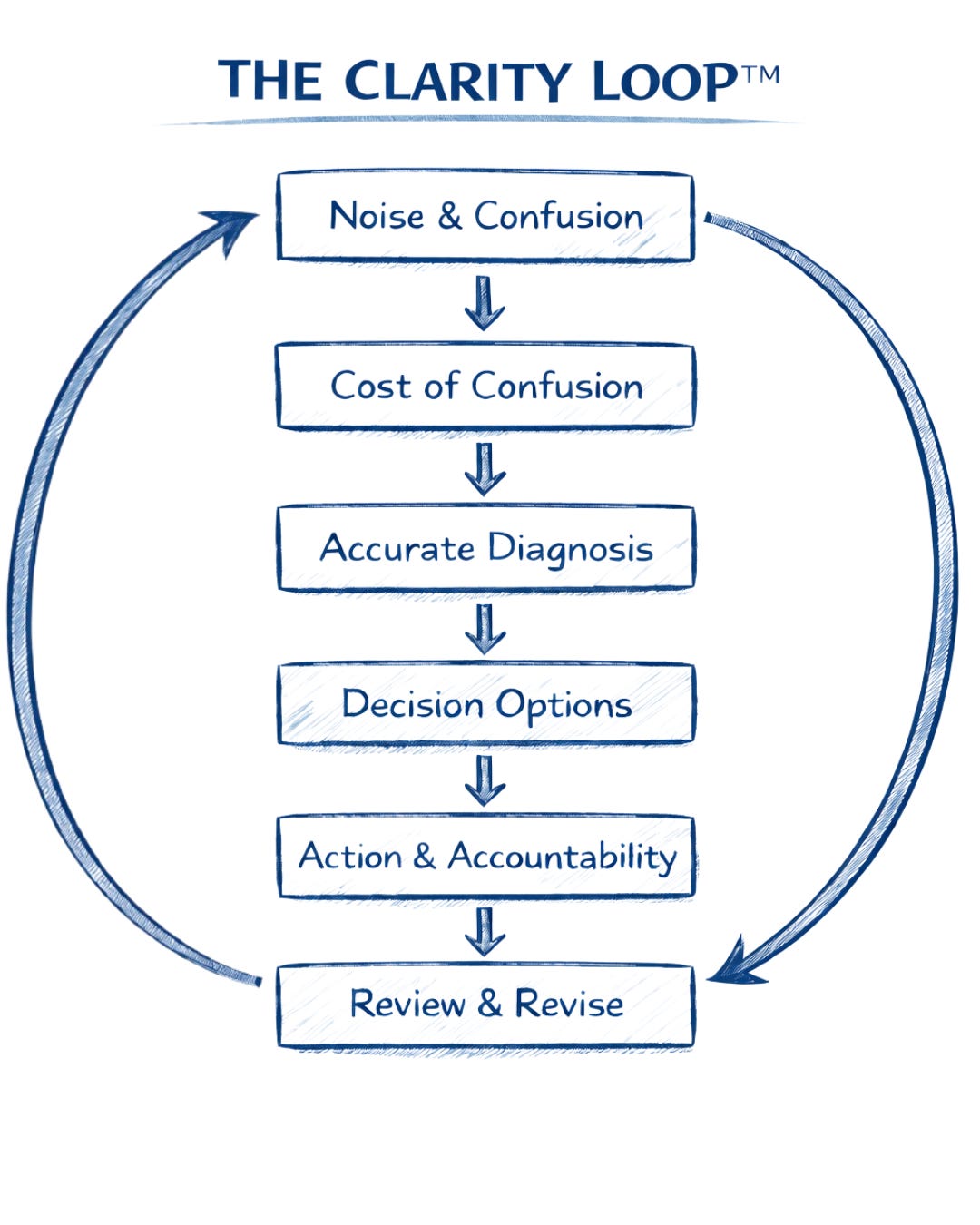
Training your mind to constantly do this ensures this becomes an automatic thought process throughout your life.
Clarity isn’t a one-time breakthrough.
It’s a capability you build.
What this month is about: building your foundation first
Clarity doesn’t remove complexity.
It gives you the ability to cut through it with precision, without losing yourself in the noise. The Clarity Loop is your thought operating model that will enable you to navigate through obstacles along the way to your destination.
When clarity returns, people find that:
Decisions feel lighter.
Energy stops leaking.
Priorities organise themselves.
Direction replaces confusion.
I’m building this because I’ve watched too many capable people burn energy on the wrong problems in their lives.
If any of this resonated, you’re not behind.
You’re simply living in a world that never taught clarity as a skill.
That’s what this month is about.
Getting our foundation right.
If this resonated and you’re tired of the unfiltered noise in your life, please feel free to join the cause in cutting through all of this complexity.