
This is all of us
A tale of thinking everything, everywhere, all at once.


There is a version of this story that belongs to almost everyone.
It doesn’t look dramatic from the outside. But internally, it feels relentless. A constant stream of thoughts, responsibilities, expectations and pressure that never quite switches off.
I once worked with a client, let’s call him Dave.
On paper, Dave was doing everything right. He had a stable job, clear ambitions, and a life that looked “on track.” But when he described his daily experience to me, something didn’t sit right.
And this was because it was so familiar.
A familiar snapshot of Dave’s reality
His alarm rings every morning and, like most of us, he hits snooze. Once. Then again. Each delay quietly builds a sense of urgency, until the day begins not with intention, but with pressure.
Before he even gets out of bed, he reaches for his phone.
The news is always the same. Another war, another tragedy, another reason to feel uneasy about the world. It leaves a subtle weight sitting on his chest before the day has even begun.
Then come the messages. Emails. Notifications.
A missed call from his mum, who he hasn’t visited in weeks.
He tells himself he’s just busy and overwhelmed. But the guilt lingers longer than he’d like to admit.
By the time he finally gets out of bed, his mind is already racing.
He hasn’t even started the day.
And yet, he already feels behind.
The commute doesn’t help.
What should be a short drive stretches into something much longer, giving his thoughts more time to spiral. By the time he arrives at work, he’s already mentally drained.
The day follows a familiar pattern.
More demands.
Shifting expectations.
Work he invested weeks into suddenly changing direction.
He stays professional, of course. But internally, the frustration builds. There’s a quiet sense that no matter how much effort he puts in, it’s never quite enough.
Throughout the day, he moves constantly between tasks, messages and conversations.
Work blends into everything else.
There’s no clear boundary. No real pause.
By the afternoon, the fatigue has set in.
But he keeps going because he feels like he has to.
By the time he leaves, it’s already late.
The drive home is slow. More traffic. More time lost.
And then the reality outside of work returns.
Bills. Expenses. Pressure.
The salary he worked so hard for is already allocated before he’s even had a chance to enjoy it.
When he gets home, he’s exhausted.
Too tired to cook. Too tired to think.
So he orders food, sits in front of a screen, and tries to switch off.
But his mind doesn’t switch off.
It’s 10pm before he realises the day is over.
He hasn’t reset for tomorrow.
He hasn’t really rested.
And as he lies in bed, the thoughts return:
What happens if the worldwide oil shortage is ongoing?
What do I need to fix tomorrow?
When does this all get better?
And then the next day…
It repeats.
If you have children, or you’re building something, or you’re carrying multiple responsibilities at once — you can multiply the intensity of this experience.
The details might change.
But the weight of it doesn’t.
This isn’t a time problem
Most people assume this is a time management issue.
That they need better routines, more discipline, or a more efficient system.
But the research tells a different story.
Studies on cognitive overload show that when the brain is exposed to constant inputs, including information, decisions and interruptions, our ability to think clearly starts to decline. Prioritisation becomes harder, worsening decision-making and heightening stress.
At the same time, global data suggests that over 12 billion working days are lost every year due to anxiety and depression, much of it linked to mental overload and workplace pressure.
In simple terms:
When your mind is overloaded, you don’t just feel worse.
You think worse.
So what do most people do?
They try to do more.
More structure.
More productivity.
More effort.
But that’s where things go wrong.
Because we are trying to fix the feeling rather than the root cause of it.
The turning point
When Dave explained all of this to me, I asked him one simple question:
“What specifically would need to change for you to be at peace?”
He paused.
Because for the first time, he realised he didn’t have an answer.
The Clarity Principle
Clarity before action reduces wasted time, energy and money.
Most people are incredibly efficient at doing things that don’t actually serve them.
So instead of giving Dave more tools, more structure, or another system to follow, I gave him something different.
A way to think.
A way to remove noise before taking action.
The CLEAR™ Framework
This is not a productivity tool.
It’s a clarity diagnostic you can return to whenever things feel overwhelming, misaligned, or unclear.
It’s a way of rewiring your thinking patterns to align with what truly matters to you.
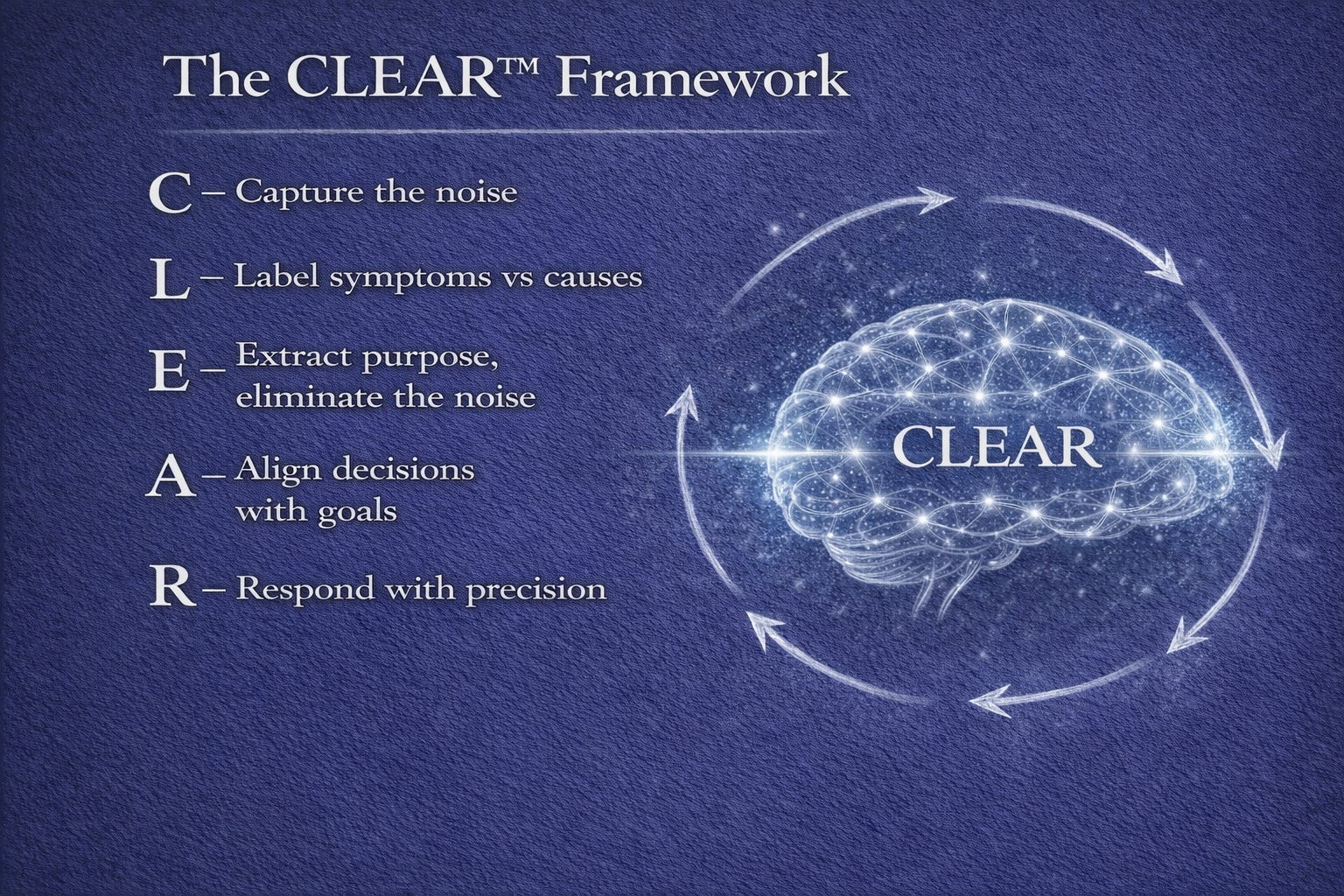
Drawing from Dave’s all too familiar experience, we break this down below.
C — Capture the noise
We started by getting everything out of Dave’s head.
Every concern.
Every pressure.
Every unfinished thought.
No filtering. No solving.
Just capturing.
There’s strong evidence behind this. Externalising thoughts, even through simple writing, reduces cognitive load and improves clarity. When thoughts stay in your head, they stay tangled. Once they’re out, they can be examined and stop the rumination cycle.
If it’s all swirling in your mind, it’s not clear.
L — Label symptoms vs causes
At first, Dave believed his problem was stress.
But stress was just the surface.
Through deeper questioning (similar to the “5 Why’s”), we uncovered what was really driving his experience.
His identity was tied to his work.
He felt constant pressure to keep up.
He compared himself more than he realised.
His expenses were stretching him.
He was overstimulated from constant phone use and incoming information.
This is where things started to shift because Dave realised that:
Symptoms ≠ causes
Urgency ≠ importance
Activity ≠ progress
Most people never make this distinction.
And that’s where they stay stuck.
E — Extract purpose, eliminate the noise
To know what to remove, you first need to know what matters.
Through a simple series of questions, we identified his purpose in under 10 minutes.
And what we found was simple. Dave didn’t just want career progression. He wanted meaning.
He wanted to build something that contributed to the world — specifically, a charity to support children.
Once that became clear, everything else became easier to evaluate.
We then looked at Dave’s daily behaviours and asked:
Does this move him closer to his purpose or further away from it?
This allowed him to:
Reduce constant news consumption
Stop working unnecessary overtime
Limit phone use
Let go of small habits (such as involving himself in conflict) that added pressure without adding value
Research consistently shows that reducing unnecessary cognitive input improves focus, emotional regulation and wellbeing.
And almost immediately…
The noise began to quiet down for Dave.
A — Align decisions with goals
Only once the noise reduced could we ask the more confronting question:
What actually matters to you?
Based on Dave’s purpose, he needed to make some important decisions to move him closer to his purpose. These included:
Changing his job (and a higher paying one)
Gaining an understanding of how to start a charity
Cutting down on using technology early in the mornings and in the evenings
Stop working overtime so that he could see his family
For the first time in a long time, Dave felt like he was being calmly decisive instead of reacting to everything.
He stopped making “perfect” the enemy of success.
R — Respond with precision
We didn’t create a long to-do list.
We chose one action, understanding that small wins compound into greater results.
His first step:
Apply for roles that aligned more closely with what he cared about.
At the same time, begin researching how to build his charity.
That was it.
What changed
The shift was real and noticeable.
Dave was able to fall asleep quicker.
He was far more energetic.
His mind felt quieter and more focused.
Work stopped feeling like his entire identity and became what it was meant to be, which was a source of income instead of a measure of his worth.
And because his direction was clearer…
His actions became more intentional.
What this means for you
There is a version of Dave in all of us.
The details might be different.
But the feeling is the same.
His story proved that when we work toward what we care about, it becomes food for the soul. All of sudden, we have so much pent-up energy regardless of how much sleep we have had.
Applying clarity allows us to remove what doesn’t matter and brings our focus back to what does.
Most people don’t have a thinking problem.
They have a noise problem.
And when you learn how to remove that noise…
The right answer reveals itself.
This is excellent! Wonderful grounded approach, thank you for sharing.