
You Keep Ending Up Back at Square One
Because you’re fixing the feeling, not what’s causing it.


Most people don’t realise they’re solving the wrong problem until they’ve already wasted time and energy going in circles. They end up there because they tried to solve the feeling, not what was driving it.
When people feel overwhelmed, anxious, stuck, or uncertain, they naturally try to make that feeling go away. They reorganise their day, push themselves to focus harder, or think their way towards a solution that brings immediate relief.
Sometimes that works, at least briefly.
The pressure eases, the mind settles, and it feels as though progress has been made.
But then the same feeling returns.
The same noise.
The same strain.
The same familiar loop.
At that point, most people assume the issue is them. They decide they lack discipline, resilience, or the right routine. In many cases, that is not what is happening at all. The simpler and more uncomfortable truth is that they have been trying to fix the feeling instead of diagnosing what is producing it.
Why the feeling takes over
What you feel is not always the problem itself. Very often, it is the signal that something deeper has not yet been understood properly. Overthinking is often the mind trying to resolve something that still feels unclear. Overwhelm is what happens when too many things are competing in the mind without being filtered, prioritised, or resolved. The two feed each other. One creates noise. The other gives it somewhere to spiral.
From a cognitive perspective, this is predictable. Working memory is limited, and once that capacity is exceeded, thinking becomes less deliberate and more reactive. Under pressure, attention narrows, threat detection rises, and whatever feels most urgent begins to dominate. That is why intensity so often gets mistaken for importance, and why relief can feel like resolution even when nothing fundamental has changed.
This is where people go wrong. They respond to the intensity rather than what lies beneath it.
The symptom is visible. The cause usually isn’t
The surface is always easier to see:
“I am overwhelmed.”
“I cannot stop thinking about this.”
“I feel stuck.”
Those experiences are real, but they are often outputs, not causes. That is why so many people feel as though they are constantly working on themselves without making the kind of progress that actually lasts.
Decision paralysis, for example, is not usually about incapability. It is what happens when overthinking pushes the mind past its ability to filter clearly. At that point, everything starts competing at the same volume. Priorities blur. Values clash. The decision becomes heavier than it needs to be.
If this is hitting a little too close, it’s not random.
Most people spend years trying to fix what they feel, without ever understanding what’s actually driving it. That’s how time, energy, and money get wasted solving the wrong problem.
👉 Subscribe if you want to stop going in circles.
This is not just personal
This tendency to react to the visible symptom while missing the deeper cause is not a personal flaw. It is a broader decision-making failure pattern. It shows up in individuals as overthinking and overwhelm. It shows up in organisations as wasted effort, failed initiatives, and expensive action taken against the wrong diagnosis.
That is part of what makes this issue worth paying attention to. It is not just a private psychological pattern. It is the same pattern that causes organisations to spend millions solving the wrong problem. Studies on large-scale project failures have shown that a substantial proportion of failed initiatives are linked not to poor execution, but poor problem definition at the start. The Project Management Institute has reported that around 37% of failed strategic initiatives were tied to unclear objectives and milestones. In addition, McKinsey has repeatedly written about how transformations fail when organisations act before diagnosing the real issue properly.
You see it everywhere. A company cuts costs when the real issue is a misalignment between strategic objectives and operational processes. A team increases reporting when the real issue is poor decision-making or unclear accountability. A new system is introduced to “fix” inefficiency when the underlying issue is behavioural or cultural. On the surface, these responses look productive. They create movement, but not resolution. So the same problem returns in another form.
Different setting. Same pattern.
This is why I keep saying that clarity comes before action.
Action taken against the wrong problem is not progress. It is just movement with a cost attached to it.
The deeper layer most people never get to
Even when people move beyond the surface, they often stop too early. They identify things like too many inputs, constant pressure, unclear direction, or external expectations. Those are real contributors, but they are not always the deepest driver.
Beneath those often sits something far more personal: what you believe is at stake.
Not just, “I have too much to do,” but, “If I get this wrong, what does that say about me?”
Not just, “I need to make the right choice,” but, “If I choose badly, how will I be seen?”
This is where self-worth enters the picture.
A significant amount of overwhelm and overthinking is tied not simply to workload or uncertainty, but to meaning. The mind is not just reacting to what is happening. It is reacting to what it believes that situation says about its value, competence, identity, or safety. That is why most people overthink decisions that are, in reality, reversible or changeable. The mind is not treating the decision as practical. It is treating it as personal.
And this is where perspective matters. Most of us do not judge other people’s wrong decisions anywhere near as harshly as we judge our own. We still respect them. We still notice the strengths, judgement, and abilities they bring to the table. We can usually see that one poor decision does not define their entire worth. Yet when it comes to ourselves, we often act as though one misstep is evidence of some deeper failure. That double standard is part of the overwhelm-overthinking loop.
The issue is no longer just the decision itself. It becomes a referendum on self-worth.
A shortcut to interrupting the pattern
After you capture the noise, the next step is not to rush into action. It is to create enough structure to understand what you are actually dealing with.
That is where the Clarity Filter™ helps.
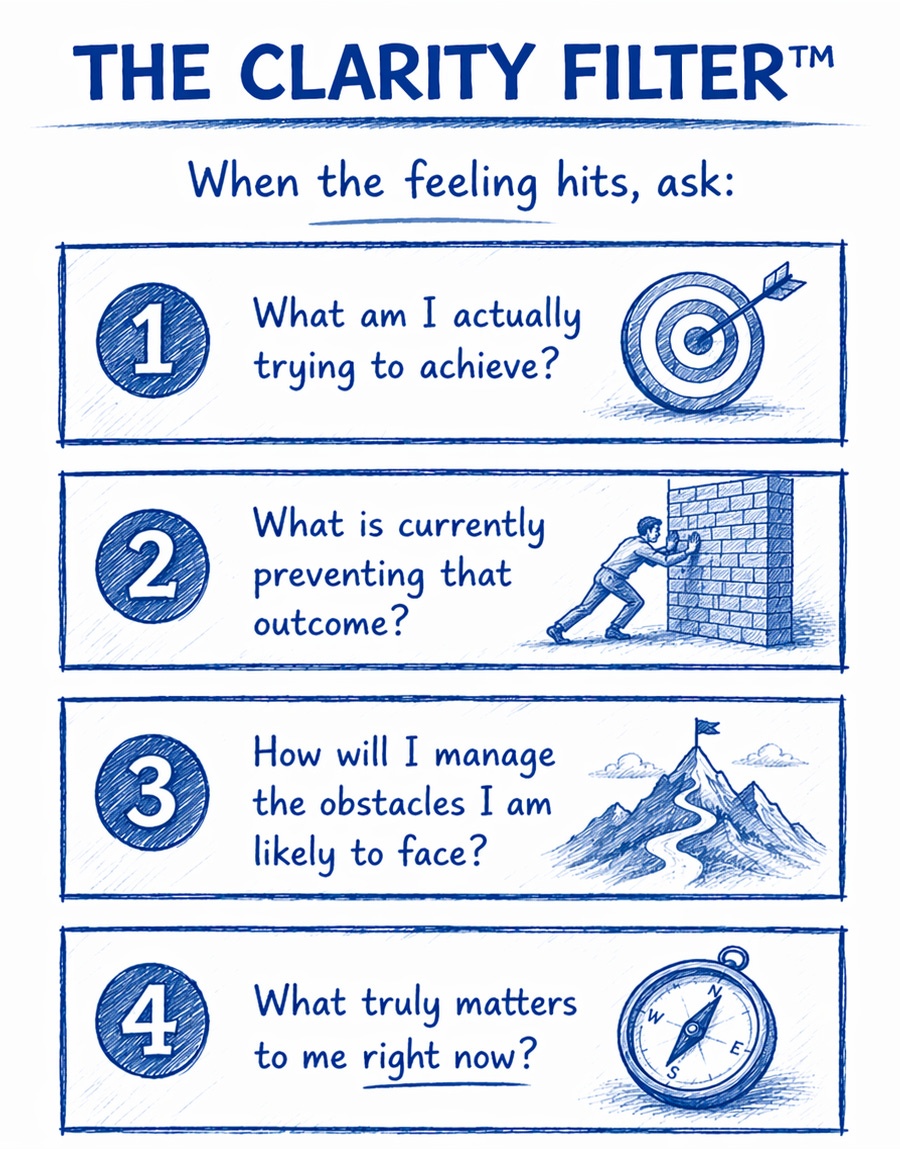
These questions help separate emotional intensity from actual importance. They shift the mind from reaction to structure and often reveal whether you are dealing with a practical obstacle, an unclear priority, or something deeper.
Sometimes that is enough. The situation becomes clearer and the pressure reduces. But if the same feeling keeps returning, it usually means the issue is not situational. It is patterned.
When the pattern keeps returning
Patterns do not sit at the surface. They sit underneath behaviour, often reinforced over many years. This is where most people stop. They notice the repetition but do not interrogate it properly. That is a mistake.
If the same issue keeps returning, it is worth going one level deeper and asking why repeatedly until the shape of the problem changes. A demonstration of the 5 Whys framework is shown below.
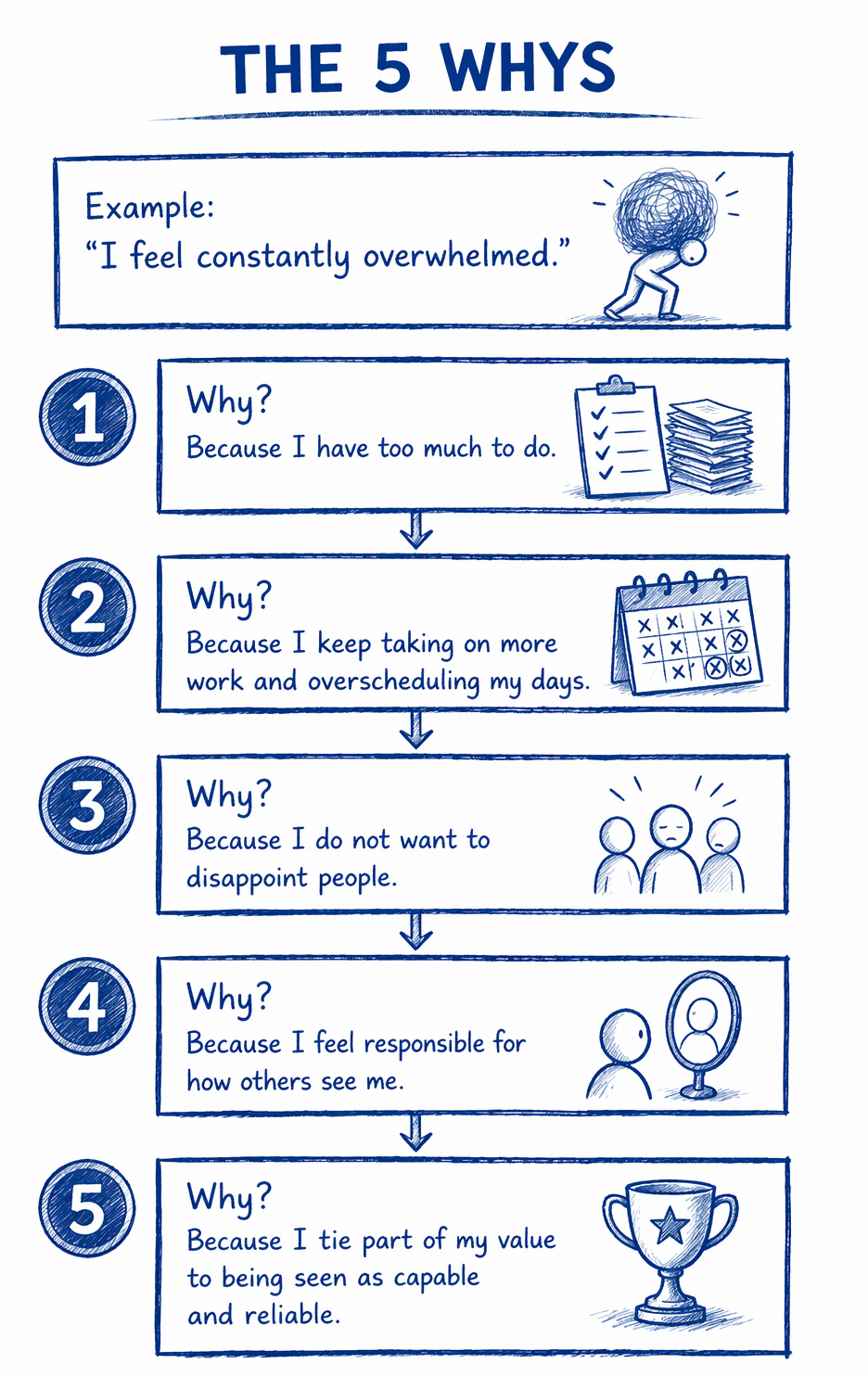
By the fifth why, the nature of the problem becomes clearer. It is not just a workload issue. It is a pattern involving approval, identity, boundaries, and self-worth. If that pattern remains untouched, the workload will continue to feel unmanageable, no matter how many productivity tools are layered on top of it.
This is why it keeps coming back
Most people think they are overwhelmed by external factors like workload, pressure, or circumstance. What they do not realise is how much of their overwhelm is tied to the meaning they are attaching to those things, and in many cases, have probably been attaching to them for most of their lives.
That is why the loop keeps returning. Not simply because life is demanding, but because old patterns keep assigning significance in ways that make every problem feel heavier, more permanent, and more defining than it really is.
You’re not overwhelmed by everything going on.
You’re overwhelmed by what your mind is still trying to solve.
If you’ve read this far, you already know this isn’t about productivity.
It’s about thinking clearly in a world that rewards noise, speed, and reaction.
Most people never learn how to do that.
They just keep solving the wrong problem — over and over again.
I write to help you see what’s actually going on, so you can stop wasting time fixing the wrong things.
👉 Subscribe if you want to think differently — not just do more.